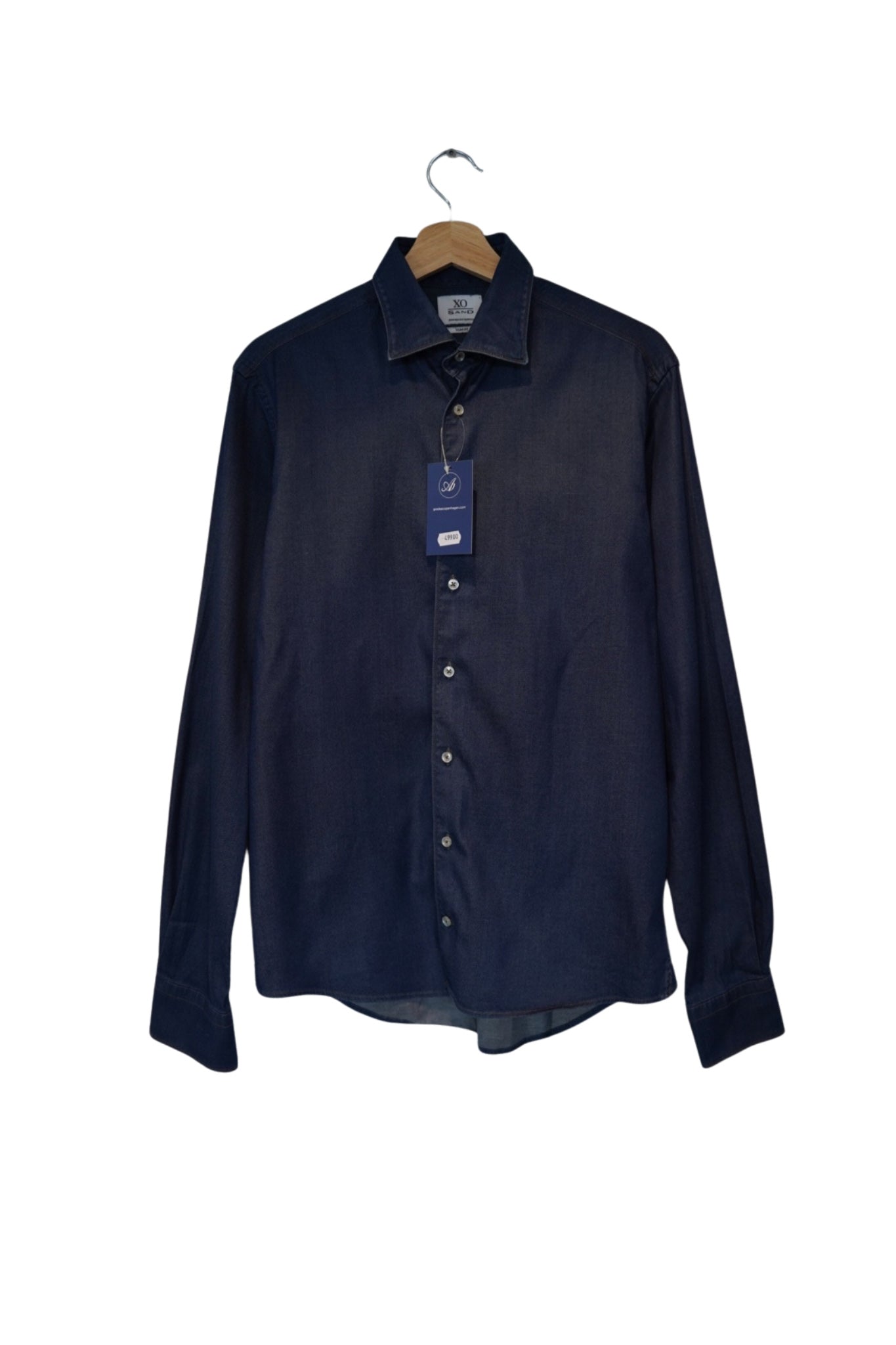
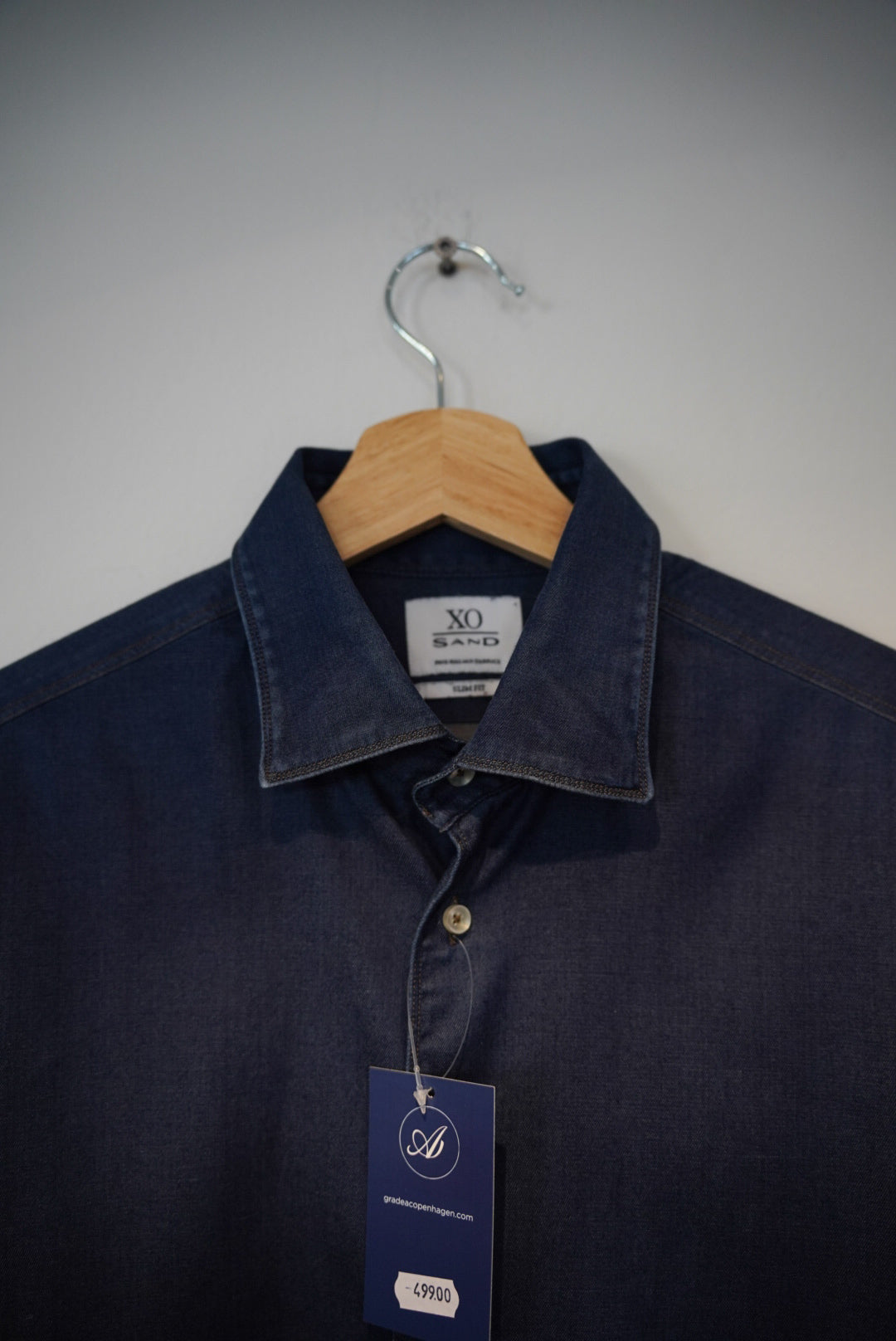
Sand Copenhagen Blue Denim Slim Fit Cotton Shirt
KUN ÉN TILBAGE PÅ LAGER. Skynd dig, inden produktet er solgt til en anden!
- Regular price
-
€68,95 - Regular price
-
- Sale price
-
€68,95
Couldn't load pickup availability
- Brand: Sand Copenhagen
- Size: 40 (corresponds to M)
- Color: Blue Denim
- Material: 98% cotton, 2% elastane
Exchange and return service | 1-3 day delivery | Free shipping in Denmark from 499,-
0000000901
Everything we sell is secondhand, and no two items are alike. The clothing comes from different decades, countries, and brands, where the same size means very different things. That is why we measure every single piece of used clothing and assign it a common Grade A size, so you can compare across the entire store.
How to read the sizes
The principle is consistent throughout: the garment's own size is listed first, and the translation is in parentheses. For shirts, the garment's own size is the letter — which is why the neck measurement is in parentheses right there.
| Category | Shown as | The number is | The letter is |
|---|---|---|---|
| Blazer | 48 (M) | EU jacket size — chest width in cm divided by 2 | Approximate t-shirt size |
| Suit | 48 (M) | EU jacket size — the jacket determines the suit | Approximate t-shirt size |
| Shirt | M (39/40) | Neck width in cm | The shirt's own size |
| Trousers | 32 (M) | Waist width in inches | Approximate t-shirt size |
| Shoes | 42 | EU shoe size | — |
| Jacket, sweater, polo shirt, rugger, overshirt | M | — | Size as stated in the garment |
| Ties and accessories | One size | — | — |
Why we write 48 (M) instead of what is in the neck
Because the label on secondhand clothing is rarely reliable — and just as often not there at all.
Sizes shift over time
An Italian 50 from 1995 does not fit like a Danish 50 does today. The cut, shoulders, and length have changed through the decades, and they still vary from country to country and brand to brand.
The label is missing
On secondhand clothing, the label may have faded away, been cut out, or washed until unreadable. In that case, there is nothing to go by other than the actual measurements of the item.
We measure every single item
Each item is measured by hand, and the Grade A size is set based on the measurements we find — not based on what is in the neck. That is why the size may differ from the label.
The Grade A size is our assessment. The measurements are the facts.
The number tells you what the item actually corresponds to. The letter in parentheses is a rough translation, so you can quickly orient yourself. But if there are measurements on the product page, those are always the ones that apply — they were taken on the exact item you are looking at.
How to measure
We measure the clothing flat — not on a body. If you do the same, you can compare directly with the measurements on the product page.
The best trick: measure something you already have
Find the piece of clothing in your own wardrobe that fits exactly how you want it to. Lay it flat, take the measurements below, and compare them with the measurements on the product page. Choose the item that is closest. It is much more accurate than guessing based on a letter size.
Tops — blazer, jacket, sweater, shirt
Chest width. Lay the garment flat with the front facing up. Measure across from one armpit to the other. Multiply by 2, and you have the circumference.
Shoulder width. Turn the garment with the back side facing up. Measure from one shoulder seam to the other, across the back.
Sleeve length. Measure from the shoulder seam to the edge of the sleeve, along the top of the sleeve.
Length. Measure vertically from the neck seam down to the bottom edge.
Trousers
Waist width. Close the trousers and lay them flat. Measure the waistband from edge to edge. Multiply by 2, and you have the circumference.
Inside leg length. Measure on the inside of the leg, from the crotch seam down to the edge of the trouser leg.
Thigh width. Measure the width of the trouser leg 3 cm below the crotch seam. Multiply by 2.
Leg opening. Measure the width of the trouser leg at the very bottom edge. Multiply by 2.
Shirt neck width
On the shirt. Button the collar and lay it flat. Measure from the center of the button to the outer edge of the buttonhole. That number is the shirt's neck width in cm.
On yourself. Place the tape measure around your neck where the collar normally sits. Hold a finger under the tape so there is room to swallow.
Shoes
Foot length. Stand on a piece of paper with your heel against a wall. Make a mark at the longest toe and measure the distance from the wall to the mark.
Measure at the end of the day. Feet get a little larger during the day. Measure in the afternoon and go by the largest foot — the two are rarely identical.
Used shoes have settled. Leather shapes itself to the person who walked in them first. If there is anything about the fit in the product description, it is worth reading.
Size charts
The tables are for guidance and describe the system, not the individual item. If there are specific measurements on the product page, they take precedence over the table.
Blazer and suit
The number is the European jacket size. Multiply by 2, and you have the chest width in cm. Suits are sold as a set and follow the size of the jacket.
| Grade A size | Letter | Chest width | UK / US |
|---|---|---|---|
| 44 (S) | S | 88 cm | 34 |
| 46 (S) | S | 92 cm | 36 |
| 48 (M) | M | 96 cm | 38 |
| 50 (M) | M | 100 cm | 40 |
| 52 (L) | L | 104 cm | 42 |
| 54 (L) | L | 108 cm | 44 |
| 56 (XL) | XL | 112 cm | 46 |
| 58 (XL) | XL | 116 cm | 48 |
| 60 (XXL) | XXL | 120 cm | 50 |
| 62 (XXL) | XXL | 124 cm | 52 |
| 64 (XXXL) | XXXL | 128 cm | 54 |
Shirts
The number in parentheses is the neck width in cm — the measurement traditionally found in Danish and European shirts.
| Grade A size | Letter | Neck width |
|---|---|---|
| S (37/38) | S | 37–38 cm |
| M (39/40) | M | 39–40 cm |
| L (41/42) | L | 41–42 cm |
| XL (43/44) | XL | 43–44 cm |
| XXL (45/46) | XXL | 45–46 cm |
| XXXL (47/48) | XXXL | 47–48 cm |
Trousers
The number is the waist width in inches, measured on the waistband — the same number that is in the vast majority of trousers. Leg length is not part of the size; it is stated as a separate measurement on the individual item.
| Grade A size | Letter | Waist | EU / suit trousers |
|---|---|---|---|
| 27 (S) | S | 69 cm | 42–44 |
| 28 (S) | S | 71 cm | 44 |
| 29 (S) | S | 74 cm | 44–46 |
| 30 (S) | S | 76 cm | 46 |
| 31 (S) | S | 79 cm | 46–48 |
| 32 (M) | M | 81 cm | 48 |
| 33 (M) | M | 84 cm | 48–50 |
| 34 (M) | M | 86 cm | 50 |
| 35 (M) | M | 89 cm | 50–52 |
| 36 (L) | L | 91 cm | 52 |
| 37 (L) | L | 94 cm | 52–54 |
| 38 (L) | L | 97 cm | 54 |
| 39 (L) | L | 99 cm | 54–56 |
| 40 (XL) | XL | 102 cm | 56 |
| 41 (XL) | XL | 104 cm | 56–58 |
| 42 (XL) | XL | 107 cm | 58 |
| 43 (XXL) | XXL | 109 cm | 58–60 |
| 44 (XXL) | XXL | 112 cm | 60 |
| 45 (XXL) | XXL | 114 cm | 60–62 |
| 46 (XXL) | XXL | 117 cm | 62 |
| 47 (XXL) | XXL | 119 cm | 62–64 |
| 48 (XXXL) | XXXL | 122 cm | 64 |
| 49 (XXXL) | XXXL | 124 cm | 64–66 |
| 50 (XXXL) | XXXL | 127 cm | 66 |
Shoes
The number is the EU size. The foot length is for guidance — lasts vary between brands, and secondhand shoes have already shaped themselves to another foot.
| Grade A size | UK | US | Foot length |
|---|---|---|---|
| 37 | 4 | 5 | 23.5 cm |
| 38 | 5 | 6 | 24.1 cm |
| 39 | 6 | 7 | 24.8 cm |
| 40 | 6½ | 7½ | 25.4 cm |
| 41 | 7½ | 8½ | 26.0 cm |
| 42 | 8 | 9 | 26.7 cm |
| 43 | 9 | 10 | 27.3 cm |
| 44 | 9½ | 10½ | 27.9 cm |
| 45 | 10½ | 11½ | 28.6 cm |
| 46 | 11 | 12 | 29.2 cm |
Jackets, sweaters, polo shirts, ruggers, and overshirts
These are sold in pure letter sizes. Use the chest width as a landmark — and remember that the cut means just as much as the size.
| Letter | Chest width | Corresponds to blazer |
|---|---|---|
| S | 88–96 cm | 44–46 |
| M | 96–104 cm | 48–50 |
| L | 104–112 cm | 52–54 |
| XL | 112–120 cm | 56–58 |
| XXL | 120–128 cm | 60–62 |
| XXXL | 128 cm and up | 64 |
Still in doubt about a specific item?
Write to us with the name of the item, and we will measure it again and let you know what we find. You are also welcome to drop by the store and try it on — we only have one of each, so it is worth calling first.